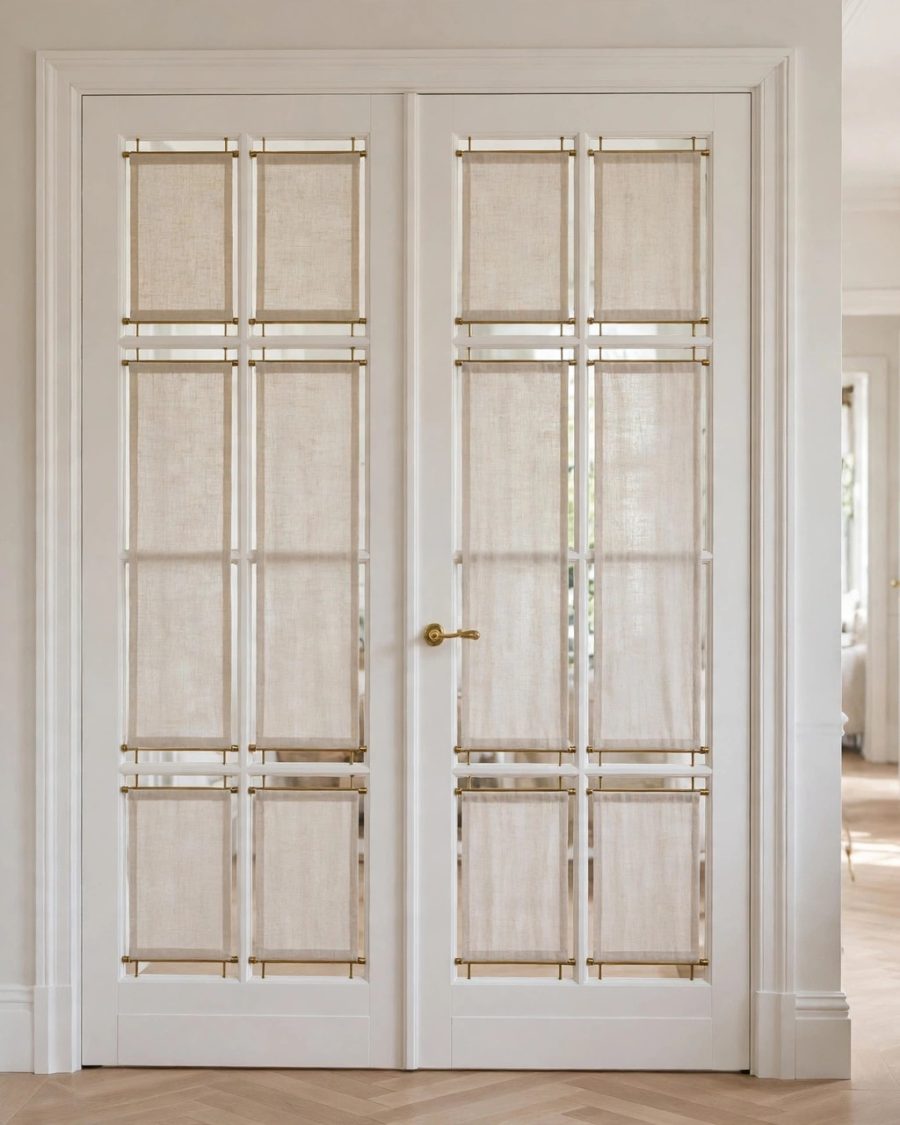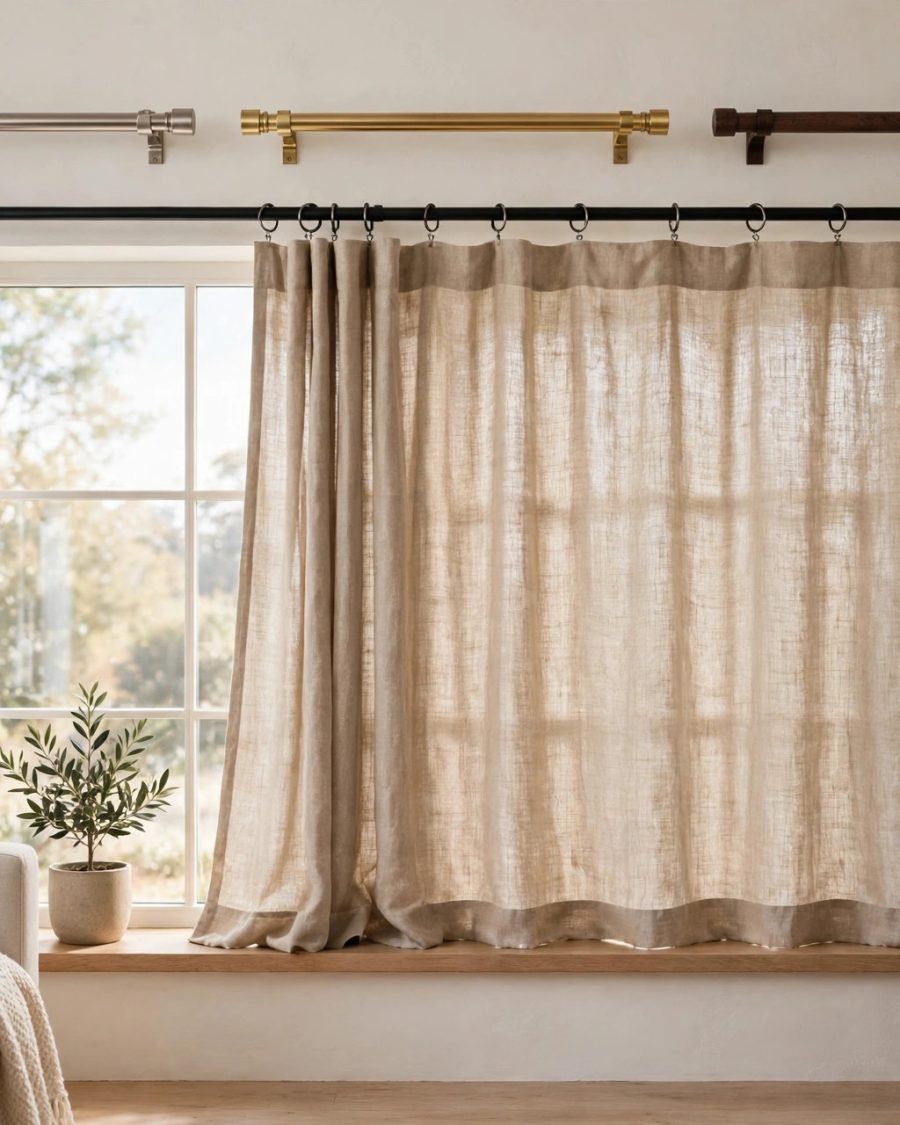

Kitchen curtains work harder than any other curtains in the house, facing steam, splashes, and frequent washing. The right pair handles all of that without fuss, gives privacy where it matters, and lets in the morning light.
This guide covers style, fabric, and fit — cafe curtains, measuring, washable fabrics, and ideas for small windows, layering, and colors for 2026.
Table of Contents

How to Choose Kitchen Curtains: Function First
Decide what the curtains must do before choosing a color. Above the sink, the fabric must cope with water, steam, and frequent washing. Beside the stove, it must be short and well clear of heat. Facing a neighbor, it must give privacy at eye level, not block the light.
Start with three questions. How often will you wash them? Cotton and cotton blends usually go in the washing machine; velvet and anything dry-clean-only becomes a chore above a sink. How much light do you want? A sheer or half-height cafe curtain keeps the top open. How close is the fabric to water and heat? The closer it sits, the shorter it should be.
Choose the length from the job, not from habit. Sill length suits most kitchen windows, ending at the sill and clear of the countertop. Apron length, just below the sill, works when the sill is narrow. Full length belongs only in a separate dining area.
What Are Cafe Curtains?
Cafe curtains cover the lower half of a window, from about the midpoint down to the sill, leaving the top open — privacy at table height without losing daylight, which is exactly why they suit kitchens.
A cafe curtain, also called a tier curtain, usually hangs on a tension rod inside the frame, or on a slim rod at the window midpoint — about half the window height, so the lower half is covered and the upper half stays open. From outside, a person at street level sees the curtain, not the sink; from inside, you still see the sky and the light over the top.
Cafe curtains suit almost any kitchen window wider than it is tall, or roughly square — above a sink, beside a stove, or on a small window that would look crowded with full-length panels. They are easy to change, too: short and using little fabric, a new pair is a small job. Add a valance for a finished look.
How to Measure Kitchen Curtains for Cafe Curtains
Measure first, then buy: kitchen windows are often smaller and less standard, so a pair bought by guesswork is likely to hang too short, too narrow, or too close to the countertop.
For an inside mount, measure the width inside the frame at the midpoint, where the rod will sit. A tension rod fits inside the frame with no brackets — good for rentals and tiled walls. For an outside mount, measure the full frame width and add 3 inches on each side, so the rod extends beyond the trim and the curtain can stack clear of the glass.
For the length, measure from the rod down to the sill, then subtract 1 inch, so the curtain ends just above the sill. That is the sill length. Common tier lengths are 24 and 36 inches, but always check your own measurement first — sill heights vary. If you fall between sizes, choose the shorter length.
For the width, total panel width should be 1.5 to 2 times the rod length, so the folds look generous when closed. For a sheer cafe curtain, allow 2.5 to 3 times the rod length. Add up the stated panel widths before you buy, and size up if you are between sizes. Wide openings need the same generous approach as curtains for sliding glass doors, where narrow panels leave gaps at the edges. For a step-by-step walkthrough, see this curtain measuring guide.

Fabrics That Survive a Kitchen
The best kitchen curtain fabric is one you can wash without thinking twice. Cotton is the classic choice: breathable, easy to wash, and available in plain weaves, gingham, and ticking stripes. Cotton blends, often cotton mixed with polyester, hold their shape better and crease less — which matters for a short curtain seen up close.
Linen blends offer a relaxed, textured look in warm white, oatmeal, and soft sage. Pure linen creases easily and can shrink if washed hot, so a blend is usually more practical. Linen-look polyester is the lowest-maintenance option: it imitates linen, resists creasing, dries quickly, and stands up to frequent washing.
Avoid velvet and anything dry-clean-only above a sink or stove. Velvet is heavy, holds cooking smells, and belongs in a living room or bedroom, not where it will be splashed. Choose a tight weave, and check the care label: if it cannot be machine washed, it will spend more time at the cleaner than on the window.
Small Kitchen Window Ideas
A small kitchen window needs a curtain that adds privacy without shrinking the room. A short cafe curtain is often the best answer: it covers only the lower half and leaves the top open to light. A sheer cafe curtain goes further, softening the view from outside while barely dimming the room.
Keep the color light: white, warm white, cream, and pale stone make a small window feel larger, while a dark panel can make it feel like a slot. For pattern, choose a small check or a fine stripe to suit the scale of the window.
Use a slim rod and a simple header. A tension rod inside the frame keeps the curtain neat and avoids brackets on tiled walls. A narrow rod pocket or tab top suits a casual kitchen; a grommet header suits a wider window you open often. Hang the rod at the midpoint for a cafe curtain, or just below the top of the frame for a valance. Keep it clear of the taps and splash zone.
Sheer Plus Cafe Layering
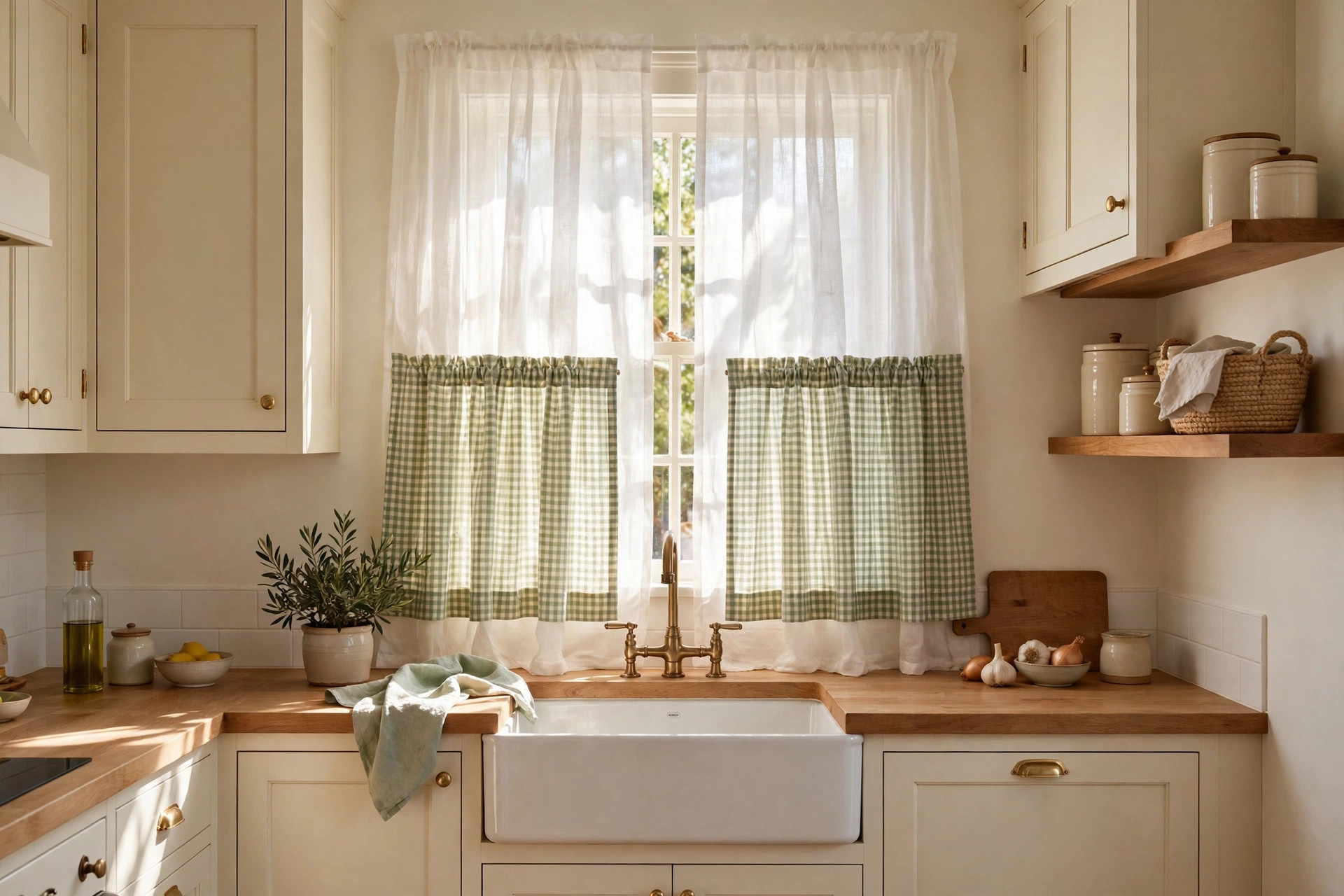
Layering works in a kitchen as well as in a living room, as long as it stays light and washable. A sheer plus cafe combination gives two layers: a sheer across the full window for daytime softness, and a cafe curtain across the lower half for privacy at eye level. Both layers are short, so neither blocks the light.
Hang the sheer on a tension rod near the top of the frame, and the cafe curtain on a second rod at the midpoint. By day, both stay closed and the kitchen feels bright but private. In the evening, draw the cafe curtain aside and let the sheer soften the glass. Use the same washable fabric family for both, such as cotton voile and cotton, so they can be washed together.
This suits a kitchen facing a neighbor or a street, and a large window over the sink, where a full sheer alone would feel too bare and a lined panel too heavy. Keep both layers short and pale, and skip a heavy lining: the point is light, not insulation.
Kitchen Curtain Colors and Patterns for 2026
Warm neutrals lead kitchen curtain colors for 2026: warm white, cream, oatmeal, soft taupe, and pale stone. They brighten a kitchen, go with wood, tile, and painted cabinets, and stay fresh long after a trend has passed — and a pale curtain keeps a small kitchen window open.
Soft sage and muted blue are the most useful accents, especially with white cabinets and a wood countertop. They add color without darkening the room, and work with plants, ceramics, and natural wood. Forest green works in a larger kitchen as a cafe curtain, but keep it to the lower half. For more on that green room by room, see our Christmas curtains guide, which includes a kitchen section with short check curtains.
Checks are the classic kitchen pattern, and they suit 2026 without looking dated: green-and-cream gingham, red-and-cream gingham, or charcoal-and-white windowpane check. Ticking stripes are the other safe choice: fresh, suited to a modern kitchen, and easy to pair with plain cabinets. Avoid large novelty prints — they date quickly, and a short curtain is the wrong place for a big motif.
Mistakes to Avoid With Kitchen Curtains
The most common mistake is a curtain that is too long. A full-length panel above a sink gets splashed, catches on taps, and blocks light, while a sill-length cafe curtain does the job better. Measure from the rod to the sill, subtract 1 inch, and trust the number rather than the size on the packet. The second mistake is a fabric you cannot wash: check the care label, and choose cotton, a cotton blend, or linen-look polyester that can be machine washed.
The third mistake is panels that are too narrow. A flat curtain with no folds looks unfinished and leaves gaps, so aim for total panel width of 1.5 to 2 times the rod length, or 2.5 to 3 times for a sheer. The fourth is hanging the rod in the wrong place: too low, and it covers the whole window; too high, and it leaves the lower half exposed. The fifth is forgetting heat and water: keep curtains clear of the stove, the hob, and the splash zone, and never hang a long, loose panel where it can catch on a handle or a tap.
Frequently Asked Questions About Kitchen Curtains
What length should kitchen curtains be?
Sill length suits most kitchen windows: measure from the rod to the sill and subtract 1 inch. Common tier lengths are 24 and 36 inches, but always measure your own window first.
What are cafe curtains?
Cafe curtains, also called tier curtains, cover the lower half of a window, from about the midpoint down to the sill, leaving the top open. They give privacy at eye level while letting daylight in, usually on a tension rod at the midpoint.
What is the best fabric for kitchen curtains?
Cotton, cotton blends, and linen blends are best, because they are washable and practical. Avoid velvet and anything dry-clean-only above a sink or stove.
How wide should kitchen curtains be?
Total panel width should be 1.5 to 2 times the rod length for most fabrics, or 2.5 to 3 times for a sheer cafe curtain, which needs more fullness.
Can I use a tension rod for kitchen curtains?
Yes. A tension rod fits inside the frame without brackets or drilling, which suits tiled walls and rentals, and works best for short, light cafe curtains and sheers.
Do kitchen curtains need to be washable?
Yes, in practice — kitchen curtains face steam, splashes, and cooking smells, so they need regular washing. Choose a fabric you can machine wash.
What color kitchen curtains work in a small kitchen?
Warm white, cream, oatmeal, and pale stone work best, keeping a small window bright and open. Soft sage and muted blue add color without darkening it. Keep patterns small, such as a fine check or narrow stripe.
Conclusion
Kitchen curtains work best when chosen for the kitchen first and decoration second. A short cafe curtain in a washable fabric gives privacy at eye level, keeps the top open to light, and survives steam, splashes, and frequent washing. Measure from the rod to the sill, subtract 1 inch, allow 1.5 to 2 times the rod length in width, and hang the rod at the midpoint.
Choose cotton, a cotton blend, or linen-look polyester you can wash without a second thought, keep the colors pale and the pattern small, and layer a sheer over the cafe curtain for extra privacy. Your kitchen curtains will then make the busiest room in the house feel brighter, calmer, and easier to live with.