
Christmas curtains do more than dress a window. They set the mood, soften winter light, add warmth on cold evenings, and frame the view outside. The best holiday window treatments do not shout. They work with the room you already have, add one or two seasonal notes, and still look right when the tree comes down.
This guide is room by room. Instead of a matching set for every window, think about what each room needs: privacy and drama in the living room, calm in the bedroom, practicality in the kitchen, warmth in the dining room, and a welcoming first impression in the entryway. The key looks for 2026 are forest-green velvet, pale winter-light sheers, warm neutrals, check patterns, and sheer-plus-velvet layering.
Table of Contents
How to Choose Christmas Curtains Room by Room
Decide what the curtains must do before choosing a color. A living-room window facing the street needs privacy after dark. A bedroom window needs to block early light. A kitchen window needs fabric that can cope with steam, splashes, and frequent washing. When function comes first, the festive part becomes easier — and cheaper.
Start with the neutrals you already live with: warm white, cream, oatmeal, soft taupe, and pale stone. They work in January as well as December. Add Christmas color in the layer you can change most easily — the outer curtain, the tieback, or a shorter seasonal panel. Aim for panels one-and-a-half to two times the window width when closed, so the folds look generous. Hang the rod a few inches above and wider than the frame, so panels can stack clear of the glass by day.
Living Room Christmas Curtains: Forest-Green Velvet Over Pale Sheers
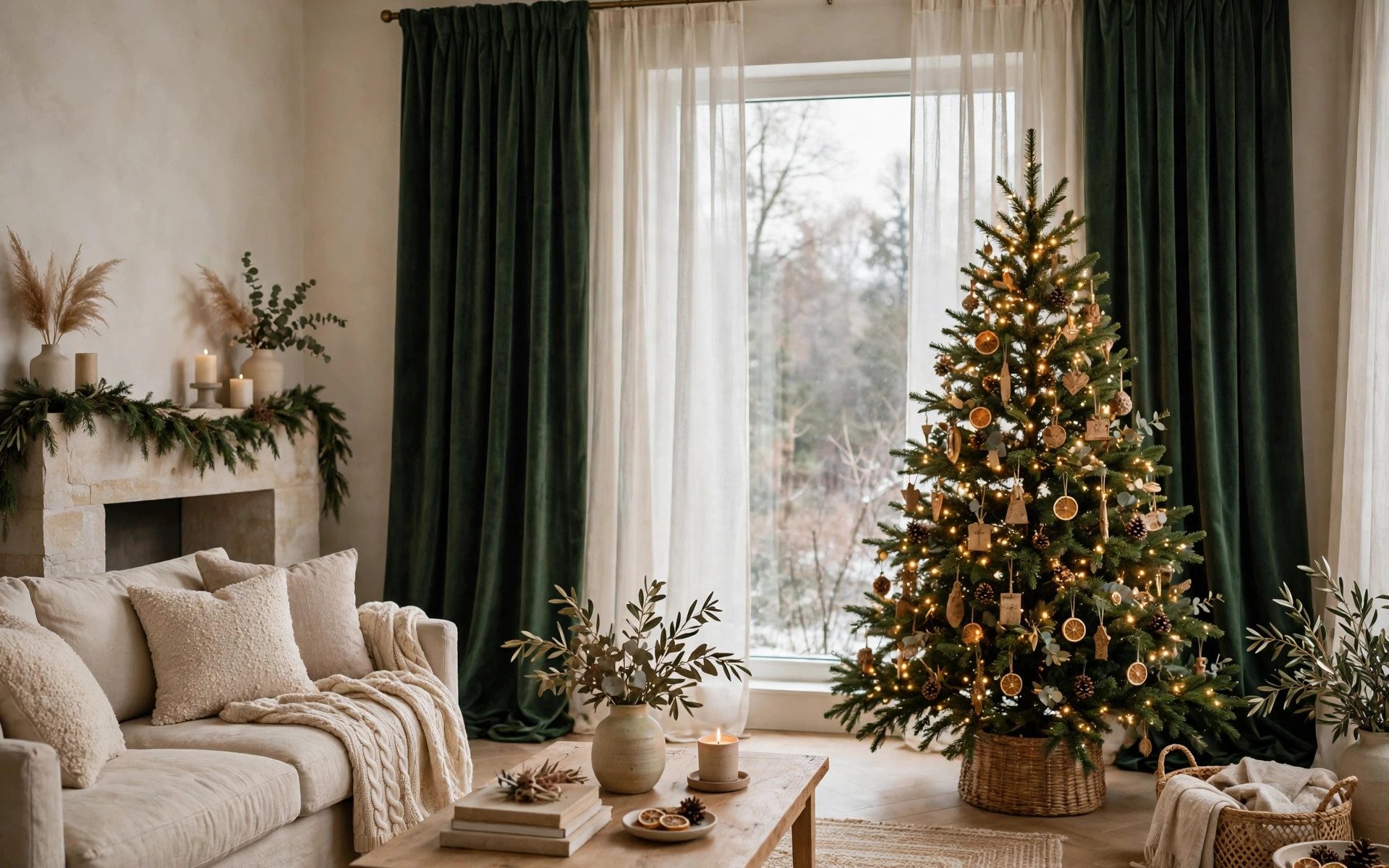
Forest-green velvet is the standout for 2026: rich without being garish, and dark enough to add warmth to a room that gets little daylight in December. Paired with pale sheers underneath, it gives two moods in one window — bright and airy by day, cozy and enclosed by night.
Hang the sheers closest to the glass on a double rod, and the velvet on the outer rod. By day, draw the velvet back with a tieback and let the sheers filter the light. In the evening, close the velvet for privacy and insulation; its weight helps a drafty window feel less cold.
Keep the rest of the room calm — a cream sofa, natural wood, a wool throw in oatmeal or camel — so the green can do the work. Add Christmas through texture: a plaid cushion in green and cream, or a simple wreath hung in the center of the window, in front of the sheers. In a smaller room, use green velvet on the main window only, and pale sheers alone elsewhere.
Bedroom: Calm, Dark, and Softly Festive
A bedroom does not need a full Christmas theme. It needs to feel restful, which in December usually means darker, heavier curtains that help you sleep. Forest-green velvet works here too, as do deep burgundy, charcoal, and warm brown — seasonal without an obvious Christmas motif.
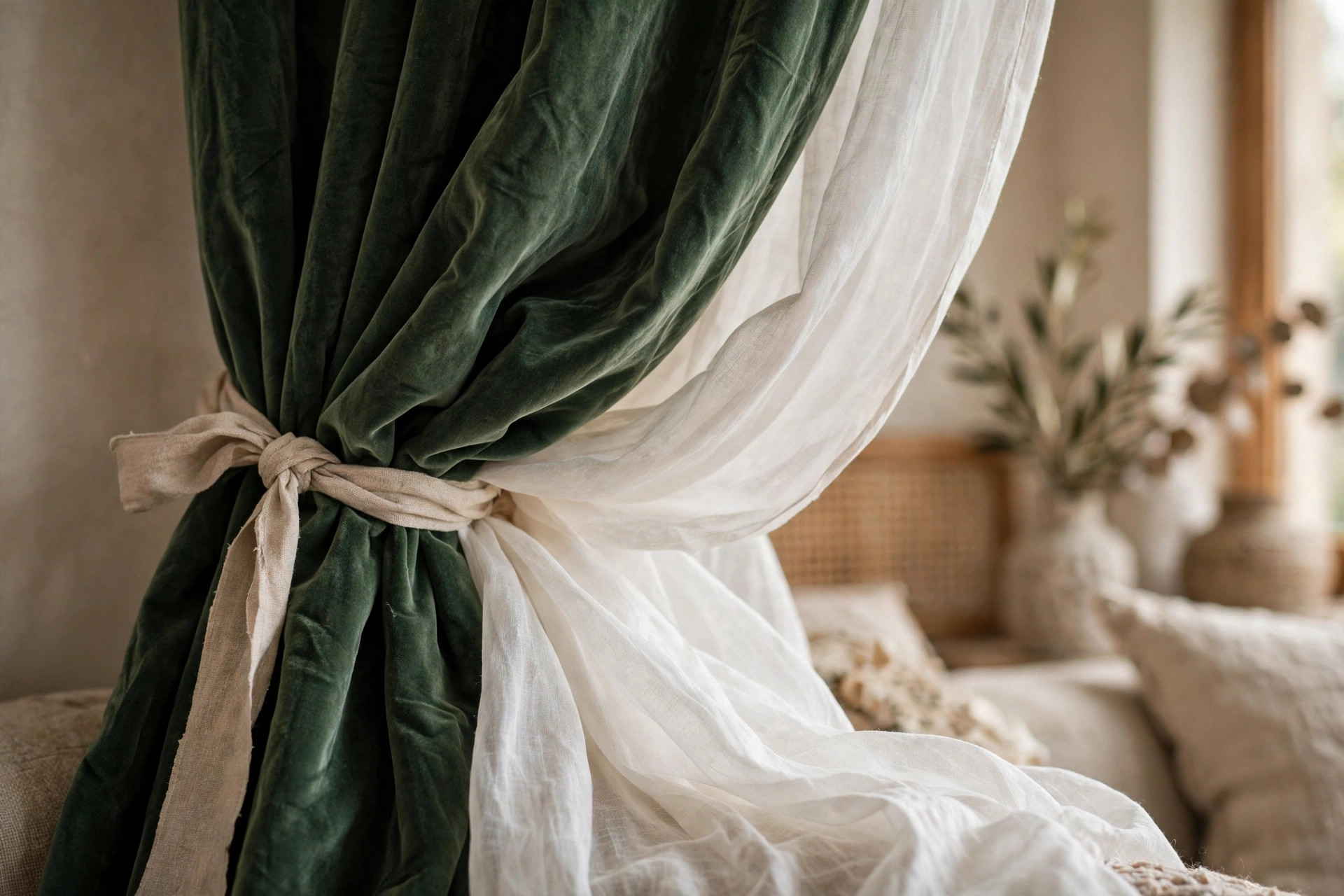
If you already have plain curtains in a warm neutral, do not replace them. Change the tieback instead: a velvet ribbon in deep green or burgundy, tied in a simple bow, is enough. A small sprig of evergreen tucked into the tieback also works, kept away from heat sources. Consider blackout lining, especially if streetlights shine through the window; it adds weight, improves the hang, and helps with insulation. If your bedroom also has a large glass door, our guide to curtains for sliding glass doors explains blackout and thermal options for wide openings. Keep patterns quiet — a subtle check, a tone-on-tone stripe, or a plain weave — and put any bolder pattern on bedding or a cushion, where it is easier to change.
Kitchen Christmas Curtains: Short Curtains and Checks
Short curtains make the most sense in a kitchen. Full-length panels near a stove or sink get splashed, catch on handles, and block light. A cafe-style curtain covering the lower half of the window, or a short valance with a half-panel, gives privacy without shutting out winter daylight.
A subtle check is the classic choice, and it suits Christmas without reindeer or snowflakes. Try green-and-cream, red-and-cream gingham, or charcoal-and-white windowpane check — festive in December, ordinary in January. A small check suits a small kitchen; a larger check suits a bigger window. Pair it with warm neutrals such as cream walls and wood countertops.
Choose fabric you can wash: cotton, cotton blends, and linen blends. Velvet and anything needing dry cleaning belong in the living room, not above the sink. Keep the curtain short enough to clear the taps and splash zone, and use a rod that lets you slide it aside easily.

Dining Room: Warmth for Long Evenings
The dining room is used most in the evenings at Christmas, so its Christmas curtains should make the room feel warm and enclosed. Full-length, lined panels in a warm neutral, deep green, or soft burgundy work well. Closed, they soften the walls, absorb sound, and make the table the center of the room. Use easy tiebacks — fabric, or a velvet ribbon in a contrasting color — and avoid long loose ends near candles.
Entryway: A Small, Welcoming Touch
The entryway is the first thing guests see, and a little curtain goes a long way there. A narrow window beside the front door, a sidelight, or a small hallway window can take a short curtain or a simple sheer. The aim is privacy without blocking light.
Warm neutrals work best for Christmas curtains, because the entryway connects to the rest of the house: a cream or oatmeal sheer, a short panel in a subtle check, or plain linen in soft green. Add a festive touch with a ribbon tieback, or a small wreath on the inside of the door rather than on the curtain. Keep curtains well above the floor, so they do not catch on coats, bags, or boots.
Christmas Curtain Patterns, Layering, and Tiebacks
Checks are the easiest way to make Christmas curtains feel seasonal without dating them. Tartan or plaid in green, red, and cream works best as an accent — a valance, a tieback, or a single panel. Gingham in red and white, or green and white, feels fresher and suits kitchens and bedrooms. Windowpane check, a large fine grid over a plain ground, is the most versatile: a smart neutral most of the year, festive in December with evergreen and warm wood.
Avoid large novelty prints — Santas, reindeer, and snowmen — on full-length curtains. They date quickly and look out of place once Christmas is over. Use them on a cushion cover or table runner instead. Texture adds interest without pattern: velvet, linen, wool, and cotton each catch light differently, and mixing them gives a room depth in low winter light. Tiebacks are the cheapest change: a wide velvet ribbon for a formal room, a narrower one for a casual room, and a ribbon can hang a light wreath in the window.
Fairy Lights and Curtain Safety
Never put candles near curtains. A naked flame and fabric are a dangerous combination, even for a few minutes. Use battery-operated LED fairy lights or LED candles instead. They give the same warm glow, stay cool, and can run on a timer. Use lights in good condition, run them along the frame or rod rather than through the folds, switch them off at bedtime, and keep curtains clear of radiators, heaters, and the hob.
For more detail, see the candle fire safety guidance from the U.S. Fire Administration, which advises keeping candles at least 12 inches from anything that burns and blowing them out when leaving a room.
Christmas Curtains in Warm Neutrals That Still Work in January
The January test is simple: will the curtains still look right when the tree and fairy lights are gone? Warm neutrals — cream, oatmeal, warm white, camel, soft taupe, pale stone — pass easily. They brighten gray days and go with almost any furniture. Plain forest green passes too, as do deep burgundy, charcoal, and warm brown. What dates a curtain is the motif, not the color: a reindeer or “Merry Christmas” print looks out of place on 2 January, while a plain green panel does not.
Frequently Asked Questions About Christmas Curtains
What color curtains are best for Christmas?
Forest green, deep burgundy, warm cream, and oatmeal are the most versatile. Forest-green velvet is the standout for 2026, especially layered over pale sheers. Warm neutrals work in every room and still look right in January.
Can I use my normal curtains at Christmas?
Yes. Keep your normal curtains and add a festive layer — a sheer behind them, a velvet ribbon tieback, a check valance in the kitchen, or a wreath in front of the sheers. It is usually enough, and much easier to reverse in January.
How do I layer sheer and velvet curtains?
Use a double rod, with the sheer on the inner rod closest to the glass and the velvet on the outer rod. Hang the sheers first, then the velvet. Both should close fully and stack clear of the glass when open. Tie the velvet back at about two-thirds height by day, and close it in the evening.
Are short curtains better for a kitchen at Christmas?
Usually, yes. Short curtains stay clear of the sink, stove, and countertop, and let in more winter light. A cafe-style curtain or short valance in a subtle check is practical and easy to wash. Choose cotton or a cotton blend.
Are fairy lights safe near curtains?
Battery-operated LED fairy lights are a safer choice than candles, which should never be placed near curtains. Use LEDs in good condition, run them along the frame or rod rather than through the folds, and switch them off when you leave the room or go to bed. Keep curtains clear of radiators and heaters.
What Christmas curtain ideas work in January?
Plain colors and warm neutrals: forest-green velvet, cream, oatmeal, camel, and soft taupe, plus a subtle check. Avoid novelty prints on full-length curtains. Remove only the seasonal piece — a ribbon, a valance, or a wreath — and keep the main curtains in place.
Can I use Christmas curtains on a sliding glass door?
Yes — choose full-length Christmas curtains in a heavy fabric with blackout or thermal lining, hung high and wide so they clear the handle and stack clear of the glass. For measuring, hardware, and headers, see our guide to curtains for sliding glass doors.
Conclusion
Christmas curtains work best when chosen room by room, not as a matching set. In the living room, forest-green velvet over pale sheers gives light by day and warmth by night. In the bedroom, calm, dark, lined curtains help you sleep, with a ribbon tieback as the only festive note you need. In the kitchen, short curtains in a subtle check are practical, washable, and bright. In the dining room, full-length lined panels make long evenings feel warm. In the entryway, a light, short panel adds privacy without blocking light.
The thread is restraint: warm neutrals as the base, one festive color or pattern per room, texture over novelty, and layering you can adjust through the day. Add LED fairy lights for glow, never candles near fabric, and choose curtains that pass the January test. Done that way, your Christmas window treatments will make the whole winter feel more comfortable, not just December.